
The Nordic gender funding gap explained
It's not what most people think.
There's a persistent assumption about the gender funding gap: that women-only founders get lower valuations, raise smaller rounds, and are systematically undervalued when they pitch. The data tells a more specific story.

The gap is real — but where it lives is not where you expect
In our 2025 Funded! report, we tracked 219 Nordic companies with women in founding roles. The average funding gap between mixed-gender and women-only founding teams was 2.8×. That's significant. But when we broke the data down by funding stage, something interesting happened.
At pre-seed, women-only founders raised more than mixed teams on average. At seed, the gap was under 10%. At the same stage, in the same market, the gap almost disappears.
So where does the 2.8× come from?
It's a stage access problem
25% of women-only founders in our 2025 dataset raised at grant stage. Only 7% reached Seed or above. For mixed teams: 13% at grant, 17% at Seed or above. Women-only founders are not being undervalued when they reach the room. They are not reaching the room at the same rate.
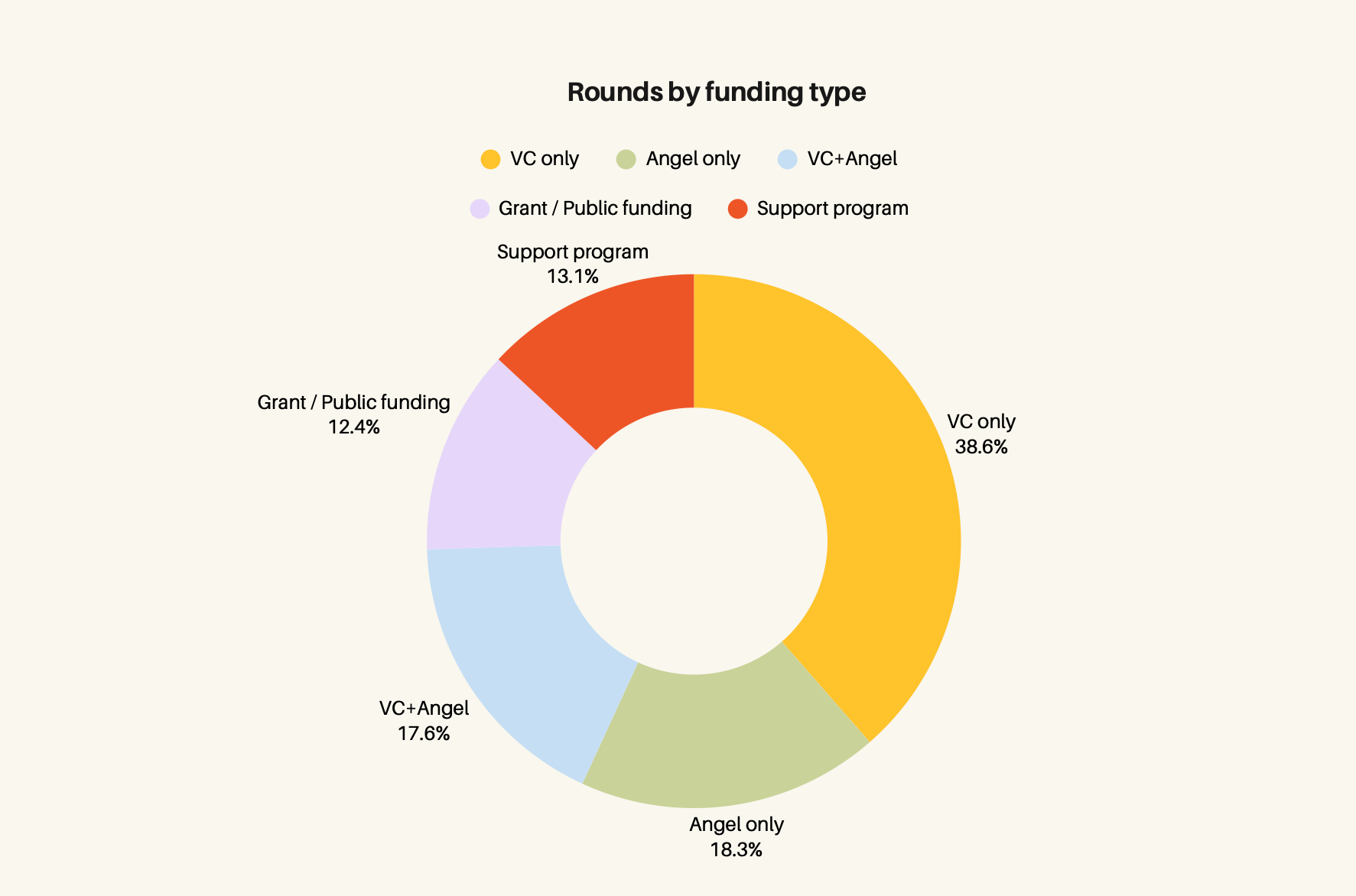
The mechanism is the referral network. Most early-stage investment decisions don't start with a cold pitch. They start with a warm introduction from a founder in a previous portfolio, an angel who co-invested before. Those networks were built over decades, mostly by people who look like the founders they backed. When investors source deals through those networks, they are outsourcing their judgment to a system that is already self-selecting. Women-only founders are largely outside that loop.
What changes when they do reach institutional capital
The 20 companies in our dataset with male founding teams and a woman CEO raised an average of €4.27M, nearly identical to mixed teams at €4.53M. The barrier is not women in leadership. It is women as the only founders.
That is a precise finding. And precise findings point to precise solutions.
What needs to change?
The most effective lever is not a public diversity target. Denmark already tried that, and the data didn't move. The most effective lever is institutional investors requiring their portfolio VCs to report privately on the gender breakdown of their portfolio companies. Not publish. Just report. Because when fund managers know that their largest LP can see that number, sourcing behaviour changes.
The Funded! 2025 report has more data, more country breakdowns, and the full Nordic investor landscape. Download it at evenfounders.com.
